- EquityResearch
- Posts
- Stop Worshipping Book Value...It’s 2025, Not 1995
Stop Worshipping Book Value...It’s 2025, Not 1995
Old metrics are flatlining. The future belongs to investors who can hear the real heartbeat of the market.

Anshulika Bansal
August 19, 2025
Hey Folks,
Think of traditional investment metrics…
P/E ratio, quarterly EPS beats, book value…as your old college mixtape.
Nostalgic, sure…
But in today’s market, they might just be background noise.
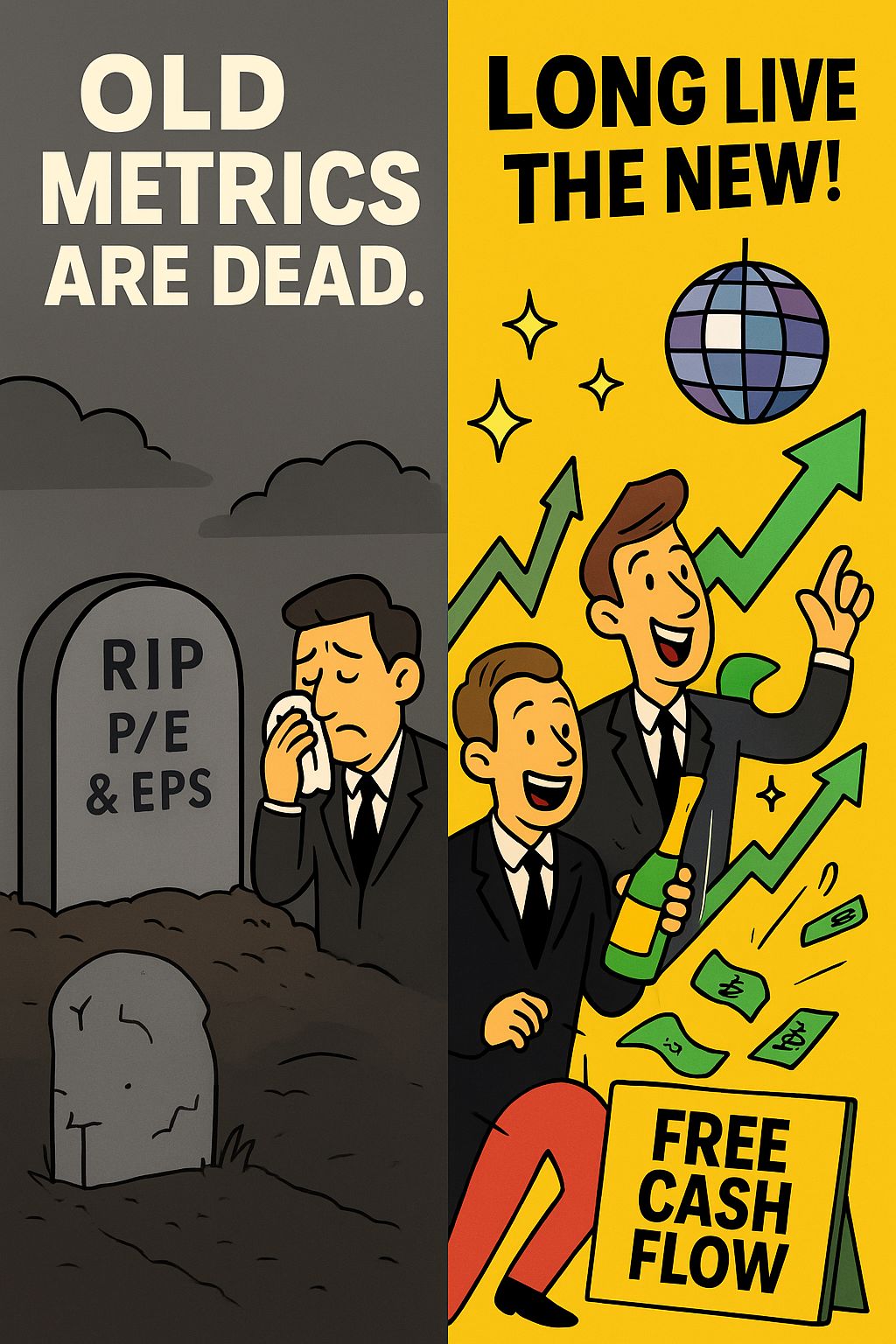
Modern markets are messy…filled with AI hype, intangible assets, and cyclical shocks. The metrics that dominated in simpler times are losing their edge.
Let’s unpack which indicators are fading into the background and which ones are quietly stealing the spotlight.👇
Why Traditional Metrics Are Losing Their Luster?

P/E Ratio: Once king, now often misleading…especially for fast-growth or low-profit companies.
As one Reddit user bluntly put it: “The literal P/E ratio is useless. Too many things throw it off.” (Link: Reddit)It doesn’t account for debt, capex needs, or future growth.
EPS & Quarterly Beats: Effective at generating buzz, lousy for long-term perspective. Investors end up chasing short-term earnings instead of sustainable value.
This shortsightedness has been flagged by academics and pros alike.Book Value: A snapshot of tangibles…totally outdated when brands, patents, and software dominate value creation. Many modern businesses don’t even own real estate.
EPS might be old news, but your portfolio isn’t. Check the numbers that actually move markets 👉 EquityResearch.ai
The Contextual Shift: Why Good Metrics Need Update?
Valuation multiples are being judged through a new lens: higher interest rates, inflation, and tighter capital markets.
Investors now demand real earnings growth, not just rising stock valuations.
(Source: The Australian)
Old metrics are stretched into distortion. It’s like using yesterday’s map while today’s roads are flooded with AI startups and market rotations.
The Metrics That Actually Matter Now
For decades, investors obsessed over EPS, P/E ratios, and quarterly “beats.”
But the market has changed. Today, companies are rewarded less for accounting tricks and more for real economic engines: durable cash flows, sticky customers, and the ability to keep winning without burning money.
The shift isn’t just academic…it decides which companies survive downturns, scale sustainably, and actually make their shareholders wealthier over time.
Old Metric (Dying) | Why It's Fading | Modern Metric (Now Matters) | Why It Works |
|---|---|---|---|
P/E Ratio | Distorted for growth/no-profit firms | Free Cash Flow (FCF) | Reveals business reality; tougher to game (Source: Investopedia, Wikipedia) |
EPS / Quarterly Beats | Encourages short-termism | ROIC (Return on Invested Capital) | Shows efficiency and sustainable value |
Book Value | Irrelevant for intangible-rich firms | Moat Indicators (pricing power, network effects) | Exposes true competitive advantage |
EBITDA | Omits capex, can mask weakness | Operating Margins & Leverage | Reflects resilience and scalability |
Revenue Growth Only | Hides poor unit economics | Unit Economics (LTV:CAC, Payback Period) | Ensures growth is profitable |
Top-Line Growth Alone | Based on hype | Retention / Churn Rates | Captures stickiness and subscription strength |
Why These New Metrics Work?
Free Cash Flow (FCF)
It’s the real, spendable cash after capital expenditures. Not manipulated.
FCF is now the cornerstone of thoughtful investing.
EV/EBITDA
A more holistic metric than P/E, it includes debt and is common in capital-intensive firm valuations.
Free Cash Flow Yield
(FCF / Enterprise Value)
Historically yielded the highest returns with fewer down cycles compared to traditional metrics.
ROIC & Margins
Measures actual capital efficiency and pricing power—not vanity metrics.
Retention Metrics & Unit Economics
In the era of subscriptions and SaaS, retention is everything. Revenue doesn’t mean profit if customers don’t stay.
Examples -
$AAPL, $MSFT , and even $AMZN stand out more for their FCF than for P/E multiples.
On the ASX, investors now demand firms have actual earnings, not just valuation exuberance. The “Rule of 40” is becoming a watchphrase again.
Amazon – The Cash Flow Juggernaut
Why it counts: EPS has always made Amazon look “overvalued” because profits were thin. While Amazon’s net income is headline-worthy, its free cash flow (FCF) tells the real story. In 2024, FCF hit about $38.2 billion, a solid den of capital even above the profit line. (Source: AlphaQuery)
Why it matters more than earnings: Net income can be fluffed by accounting tweaks. Cash is hard to fake…and that’s what funds AWS, warehouse expansion, and future growth. (Source: Level-Headed Investing)
Investors who only looked at P/E missed the juggernaut building under the hood.
Tesla – Margin Matters (Narrative Alone Doesn’t Cut It)
The hype: Tesla’s story sells: AI, Robotaxis, EV dominance. But profits tell a different tale. Yeah, EPS pops on headlines, but the real warning sign was margins.
What the numbers show: In Q2 2024, Tesla posted its lowest profit margin in over five years—about 14.6% on automotive gross margin, well below expectations—casting doubt on the sustainability of its growth narrative. (Source: Reuters)
Bottom line: A compelling narrative still needs underlying margin strength. Without it, the premium multiples can melt fast.
Adobe – Subscription Loyalty Over Old-School Assets
The switch that changed everything: Adobe transitioned from selling boxed software to its Creative Cloud subscription model. Today, deferred revenue (money paid upfront for subscriptions) sits in the billions, showing subscriber confidence and recurring cash. (Source: Adobe)
Why that’s smarter than book value: Book value can ignore intangible strength like retention and brand. Adobe's locked-in user base creates predictable profit flows…way more valuable.
EPS might be old news, but your portfolio isn’t. Check the numbers that actually move markets 👉 EquityResearch.ai
What Smart Investors Should Do?
Stop worshipping P/E. Use it for reference, not gospel.
Find real profitability. Scan for free cash flow and ROIC.
Ignore growth vanity. Focus on profitability and retention.
Value resilience in tough markets. Look for margins, unit economics, lean debt.
Use modern metrics for better clarity.
The Bottom Line
In 2025, the most “exciting” stock isn’t necessarily the best one.
The real winners are those generating actual cash, operating effectively, and building sustainable advantages.
Forget the zombie metrics Wall Street headlines still push.
Focus on the ones that tell you if a company is building resilience, growth capacity, and pricing power.
That’s how you stop playing catch-up…and start playing the long game.
Action Step:
Pick 2–3 stocks you own or track closely.
Look at the last quarter’s press release + 10-K/10-Q.
Circle the metrics they highlighted (EPS? Revenue growth? Adjusted EBITDA?).
Then pull up what actually happened to the stock after earnings.
Ask yourself: Did Wall Street reward the right thing—or were they chasing noise?
Now, try the same with metrics that matter today: free cash flow, retention, unit economics.
You’ll start spotting the mismatch between storytelling and substance.
See you next week…
EPS might be old news, but your portfolio isn’t. Check the numbers that actually move markets 👉 EquityResearch.ai
Disclaimer: This newsletter is for informational purposes only and should not be considered financial advice. Always consult with a financial advisor before making investment decisions.