- EquityResearch
- Posts
- This Rare Market Event Can Wipe Out Your Wealth
This Rare Market Event Can Wipe Out Your Wealth
Fat-tail events don’t knock...they crash the party. Learn how to hedge, diversify, and build a portfolio that survives the chaos.

Anshulika Bansal
June 09, 2025
Hey folks,
Pull up a chair, grab your coffee, and let’s talk about the sneaky stuff hiding in the market’s tail.
We’re diving into fat‑tail events…those wild, rare shocks that punch way harder than anyone’s expecting.

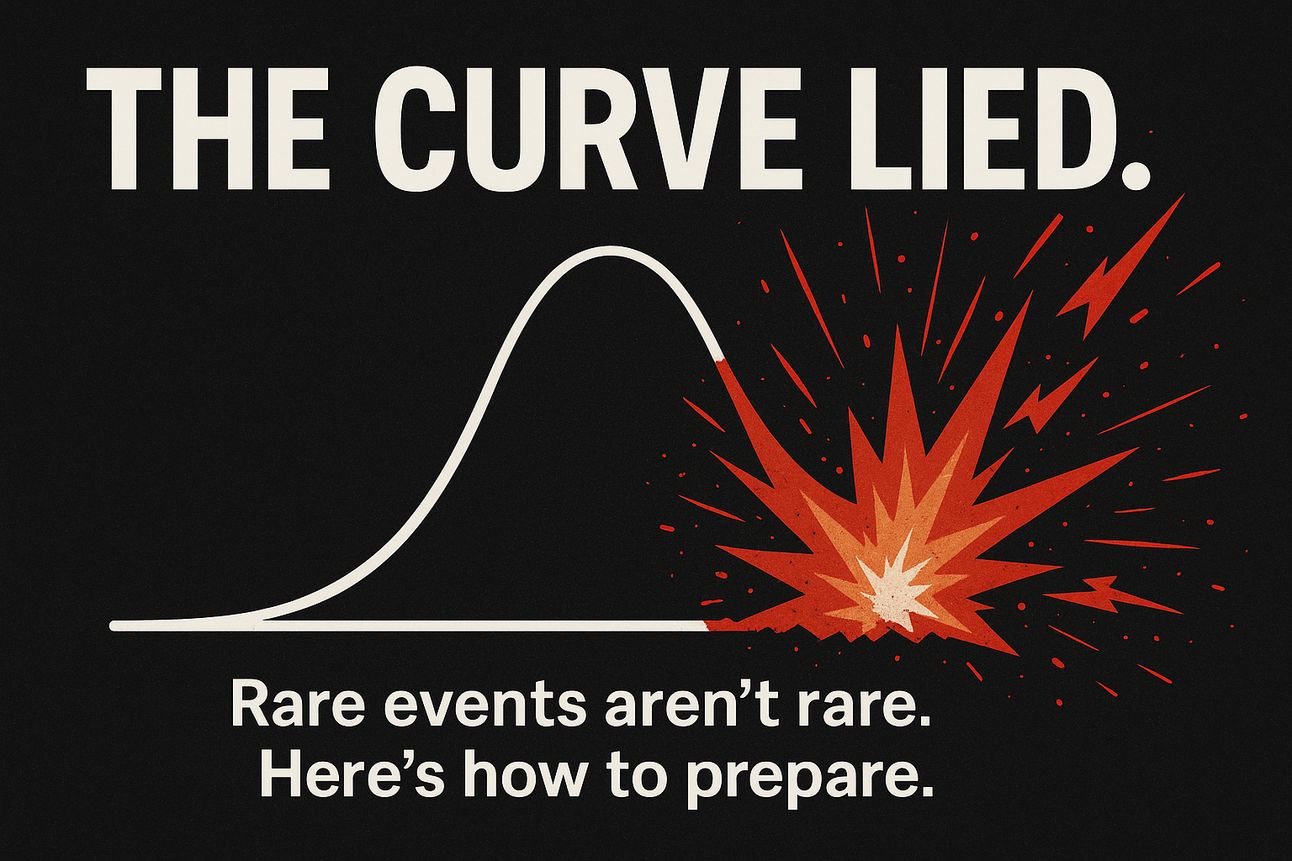
Imagine a standard bell curve of returns as a neatly folded blanket. Most of the time, everything fits nicely in the middle…returns are chill. But then... bam... the tail end bulges like a sleeping dog under that blanket.
That bulge is a fat tail.
It means extreme market moves happen way more often than the textbooks claim. You’re driving on what looks like a smooth highway, and suddenly, there’s a sinkhole.
Confused?
Keep reading…
Black Swans vs. Fat Tails - Spot the Difference
A Black Swan is like a meteor crashing into your backyard. No one sees it coming, everyone freaks out, and afterward, they pretend it was predictable all along.
For example - 9/11 Attacks (2001)
What happened: Coordinated terrorist attacks on U.S. soil caused markets to plunge.
Why it's a Black Swan:
Completely unpredictable (at least to the general public).
No market model could reasonably anticipate this.
Had huge consequences, both economically and emotionally.
After the fact, people started saying things like, “The signs were there,” but that’s hindsight bias.
Key trait: No one was preparing for it because it was beyond the imagination of most models or minds.
A fat tail, on the other hand, is more like knowing monsoon season comes every year…but still refusing to carry an umbrella.
For example: Global Financial Crisis (2008)
What happened: A housing bubble burst, subprime mortgage market collapsed, Lehman Brothers failed, and markets crashed.
Why it's a Fat-Tail event:
Rare and extreme, but not unpredictable.
There were signs: overheated housing prices, crazy leverage, mortgage-backed securities rated AAA when they were junk.
Analysts like Michael Burry and others did see it coming.
Traditional risk models ignored the probability of a chain-reaction crash, but it was within the realm of possibility.
Key trait: It wasn’t a surprise to everyone—it was just underpriced by the models and ignored by the crowd.
It’s rare, but it keeps happening.
If you want to pick quality stocks to be safe from fat-tail events,
go to EquityResearch and input the ticker.
Why You Should Give a Damn?
Underestimated Risk
Relying on traditional models is like wearing flip-flops to a snowstorm. They’re built for “normal,” not chaos.
Example: The COVID-19 Crash (March 2020)
Traditional risk models (like Value at Risk, or VaR) assumed big crashes were extremely rare.
But in just a few weeks, global markets dropped ~30%.
The models didn’t predict that something like a virus could freeze the world economy.
Takeaway: Events that models said would happen "once every 100 years" now show up every 5–10 years.
Everything Crashes Together
Your carefully built “diversified” portfolio? In a meltdown, it's like a sinking cruise ship—you’re not safer in the pool than in the bar.
Example: Global Financial Crisis (2008)
Investors held diversified portfolios with stocks, real estate, commodities, and even some bonds.
When the crash hit, everything dropped—except maybe long-term U.S. Treasuries and cash.
Why? Everyone was selling to raise cash, so correlations between assets shot up.
Mental Breakdown Zone
Huge losses don’t just hurt your money—they mess with your head. And a panicked investor is like a drunk driver during a thunderstorm. Bad combo.
Example: Retail Investors in 2008 or 2020
During sharp downturns, many panic-sold near the bottom.
In March 2020, the market dropped over 30%, and many retail investors bailed out.
But just a few weeks later, the S&P 500 began to recover—and hit new highs within months.
Those who sold locked in losses. Those who stayed in made huge gains.
How to Prep for Fat‑Tail Events?
Here’s your market crash survival kit:
A. Diversify Like You Mean It
Real diversification = holding uncorrelated assets, not just different stocks.
Example: 2022 Bear Market
In 2022, both stocks and bonds fell—a nightmare for the classic 60/40 portfolio.
But commodities like oil, natural gas, and wheat surged (especially post Russia-Ukraine invasion).
Gold held up better than equities. Bitcoin? Not so much.
Investors who had exposure to energy stocks, commodity ETFs, or non-U.S. assets fared far better.
B. Tail Risk Hedges
Buying puts costs money, but when things explode—you’re not just safe, you might even profit.
Put options: Like buying fire insurance on your house. You hope you never need it—but when the smoke comes, you’re glad you paid the premium.
Tail-risk ETFs: These are like market airbags. You don’t notice them during normal driving, but in a crash—they deploy.
Trend-following: Think of it as a thermostat. If it gets too hot (aka market tanking), it cools things down by reducing exposure.
Example: March 2020 (COVID crash)
Investors who bought SPY puts (e.g., buying the right to sell the S&P 500 at a certain price) made massive gains when the index plummeted ~34%.
Hedge funds like Universa Investments (advised by Nassim Taleb) made over 4,000% returns on tail-risk hedges.
C. Liquidity = Peace of Mind
Cash is like oxygen during a panic. Everyone forgets about it... until the room starts filling with smoke.
Cash lets you play offense when others are gasping for air.
Example: March 2009 and March 2020 bottoms
Investors who had cash on hand bought blue-chip stocks at huge discounts:
Amazon at $84 (2009)
Apple at $57 (2020)
Others were forced to sell their winners to cover margin or withdrawals.
D. Measure Smarter
If your risk model assumes a calm pond, you’ll drown when the tsunami hits.
Kurtosis & skewness: These stats are like looking at an X-ray instead of just the mirror. They show where hidden risks are hiding.
Stress tests: Like a fire drill for your portfolio. Better to discover your exit is blocked before the fire.
Example: 2008 Risk Models
Standard deviation-based models (e.g., VaR) failed because they ignored fat tails.
More sophisticated managers looked at kurtosis (fatness of tails) and skew (asymmetry)—and avoided overleveraged assets like mortgage-backed securities.
Example 2: Bank Stress Testing Post-2008
The Fed now runs annual “what if” scenarios like:
What happens to a bank’s portfolio if unemployment hits 10%?
Or if GDP drops 5%?
Investors should simulate: “What if the market drops 30%?” and plan accordingly—before it happens.
E. Risk Parity / All-Weather Strategies
Ray Dalio’s “All Weather” approach is the portfolio equivalent of packing a hoodie, sunscreen, and umbrella…because markets don’t give you a weather forecast.
Example: Ray Dalio’s All Weather Portfolio
Uses a mix of:
30% stocks
40% long-term bonds
15% intermediate bonds
7.5% gold
7.5% commodities
Held up better during periods like 2008 and 2022 because it doesn’t bet everything on “good weather.”
Different economic conditions? Your portfolio stays functional.
F. Buy Quality, Lean into Liquidity
Good businesses are like cockroaches…they survive even nuclear winters. And cash on hand lets you shop the fire sale when everyone else is selling their kidneys.
Example: Berkshire Hathaway (2020)
Held $137 billion in cash going into the pandemic crash.
Didn’t panic. Instead, they increased stakes in great businesses when prices collapsed.
Bought quality companies like Apple, Coca-Cola, and American Express at fire-sale prices.
High-quality businesses (strong cash flow, low debt) survive chaos. Cash lets you capitalize on it.
If you want to pick quality stocks to be safe from fat-tail events,
go to EquityResearch and input the ticker.
What to Do (Right Now)?

Review your allocations – Do you have too many eggs in one shiny basket?
Add hedges – Like a seatbelt. You hope you don’t need it, but one day you might.
Run “what-if” scenarios – Think of it as simulating a zombie apocalypse. Not fun…but better than getting bitten unprepared.
Set your triggers – Decide in advance what’ll make you hit pause. Panic is not a strategy.
Stick to your playbook – Don’t throw away your umbrella mid-storm.
Fat-tail events are like financial earthquakes. You can’t predict when they’ll hit—but with the right prep, you can:
Avoid total collapse
Stay calm when others panic
Use chaos as opportunity
The Bottom Line
Fat‑tail events aren’t unicorns—they’re pit bulls with wings.
Rare, but real. Dangerous if ignored.
Instead of pretending the world is predictable, build for chaos:
Diversify like a prepper.
Hedge like a pessimist.
Invest like a realist.
Because when the storm hits—and it will—you don’t want to be the person Googling “how to build a raft from toilet paper.”
Hope is not a strategy. Preparation is.
If you want to pick quality stocks to be safe from fat-tail events,
go to EquityResearch and input the ticker.
Disclaimer: This newsletter is for informational purposes only and should not be considered financial advice. Always consult with a financial advisor before making investment decisions.