- EquityResearch
- Posts
- 10 Minutes That Could Save You Thousands+ Win $50...🤑
10 Minutes That Could Save You Thousands+ Win $50...🤑
How to Read a 10-K Without Falling Asleep (Or Losing Your Mind)...

Anshulika Bansal
July 08, 2025
Hey folks,
Ever clicked on a 10‑K…and immediately thought, “Whoa, where do I even start?”
You’re not alone. These filings are legally required, painfully detailed, and written in a language that feels like a dare.
But hidden in all that fine print…Gold.
The kind of gold that helps you separate hype from healthy fundamentals—and avoid shiny stocks with hollow cores.

Imagine this: A 10‑K is like a company’s annual autobiography…it’s packed with everything investors need, but buried beneath 100+ pages of legalese and spreadsheets.
The question is: Can we get the big picture…fast? Absolutely.
Pull up a chair. Here's a 10‑minute cheat sheet that gets you the essentials…no caffeine required.
Pick your favorite ticker, go to EquityResearch and take 10 minutes with their 10‑K reader.
Minute 1–2: The “Business Overview”
The best businesses are simple. And simplicity almost always starts here.
What it is:
This is the company talking directly to you…no analyst filter, no CNBC spin. It’s where they say, “Here’s who we are, here’s what we sell, and here’s how we make our money.”
This is more like a company’s elevator pitch…what they do, how they make money, and who they sell to.
It lays out their business model, key products, segments, and where they operate.
Why it matters:
If you don’t understand the business here, the rest won’t make much sense. This section is your map.
If it's full of vague jargon or sounds like corporate poetry, beware.
Quick take:
Can you explain what this company does to a friend in one sentence? If not, pause.
Pro Tip: Look for clarity. If this section is filled with vague corporate buzzwords (“leveraging synergistic platforms to optimize digital ecosystems”), it’s often a red flag.
Bonus Alert! 🎉
Keep reading till the end…we’ve hidden a chance to win something Amazonian.
Minute 2–4: “Risk Factors”
Risk Factors aren’t just legal padding…they’re where the signals hide…
What it contains:
Think of this as the company’s worry list. Legal trouble, supply chain issues, inflation, cyberattacks, AI disruption, pandemics…you name it. If it could dent their business, it’s probably mentioned here (yes, even aliens, technically).
Some risks are required boilerplate (“global economic uncertainty”). Others are goldmines of insight (“overdependence on one customer for 40% of revenue”).
Why read it:
Most people skip this part. But this is where management has to tell you what could go wrong…and if they don't disclose a risk and it happens, they can get sued. That makes this section unusually honest.
Quick take:
Skim past the generic stuff. Look for risks that are specific, surprising, or show up repeatedly. That’s where the real signals are.
Example -
Several U.S. semiconductor companies (like $NVDA and $AMD) in their recent 2024–25 10‑Ks flagged risks tied to “controls on U.S. government export restrictions, including technology transfers to foreign nations” (Source: White & Case).
And sure enough, in mid-2025, the U.S. imposed stricter chip export rules targeting advanced AI processors, prompting concerns about revenue slowdowns and supply chain adjustments…precisely what these companies warned against.
Pick your favorite ticker, go to EquityResearch and take 10 minutes with their 10‑K reader.
Minute 4–6: “Selected Financial Data”
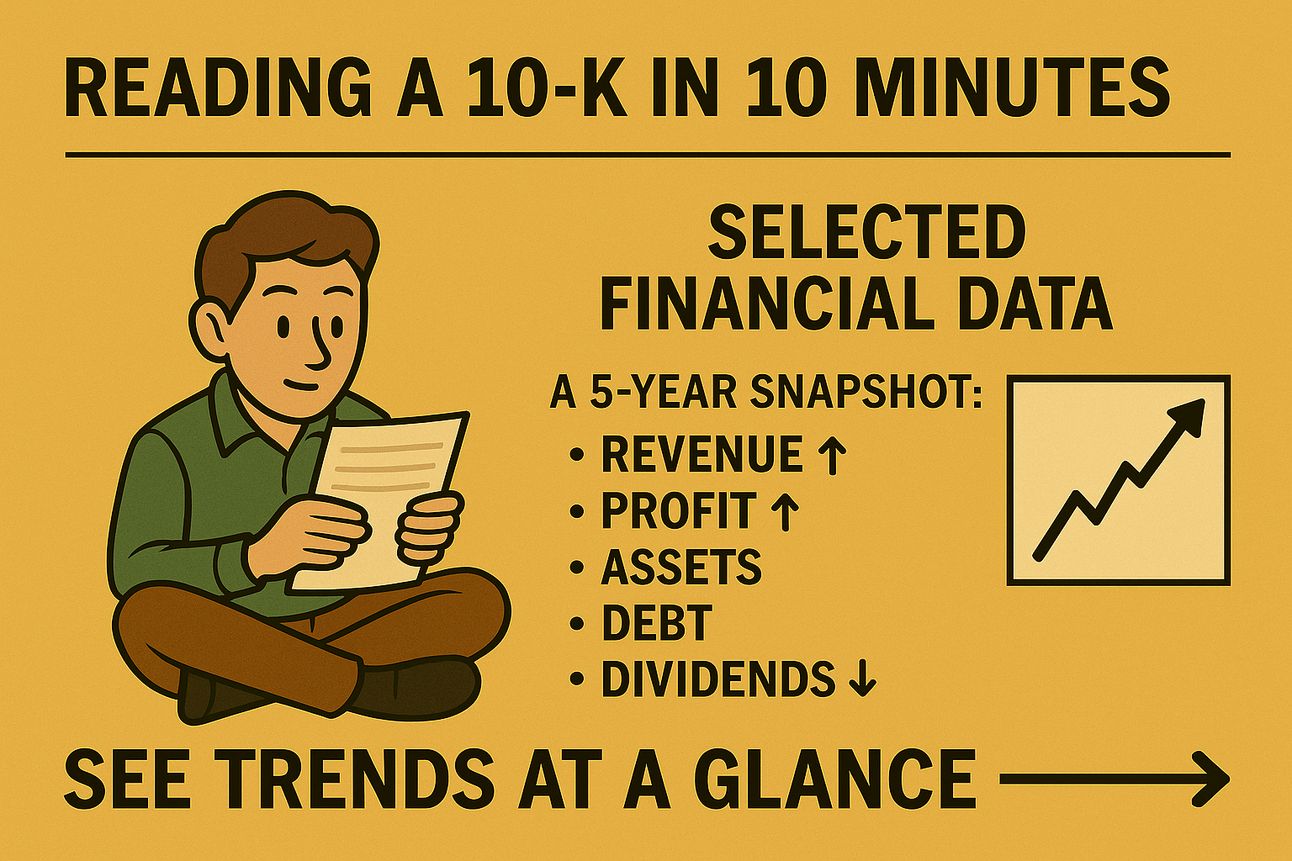
Great companies usually leave clues in their 5-year trail. Follow the breadcrumbs.
What it is:
Think of this part like a report card…but for a company, not a student.
You get 3-5 years of numbers, all lined up. Things like:
How much money they made (revenue)
How much they kept (profit)
What they own (assets)
What they owe (debt)
And if they paid shareholders anything (dividends)
It’s like flipping through a company’s baby photos…you see how they’ve grown (or not) over time.
Why it matters:
One good year can be luck. But 5 years…tells a story.
Are they growing fast? Stuck in place? Racking up debt like there’s no tomorrow?
This section lets you spot trends without digging into 40 pages of charts. A quick glance here can often answer: “Is this business actually healthy?”
Quick take:
Is revenue going up year after year—or zigzagging?
Are profits rising, or are costs eating everything?
Is debt piling up while cash is shrinking
Minute 6–8: Management’s Discussion & Analysis
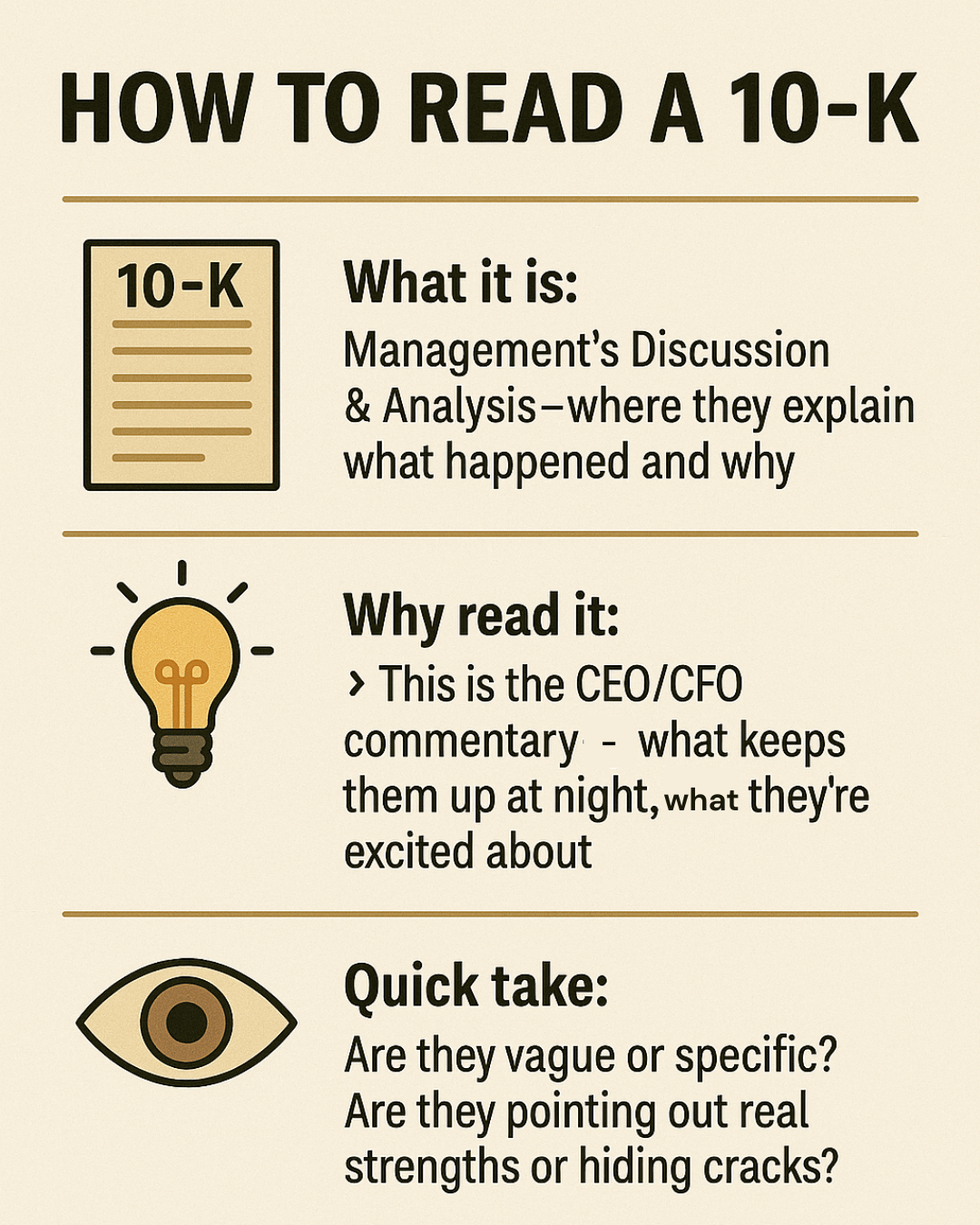
A detailed, transparent MD&A = confidence.
Vague, high-level fluff = red flag.
What it is:
This is the CEO/CFO's voice…their candid explanation of what happened, why it happened, and what's coming next. It's the narrative behind the numbers.
Why read it:
Here’s where they get real. They’ll tell you what keeps them up at night and what they’re excited about…but it's also where they can sugarcoat or hide cracks. It’s essential to sense the tone.
Quick take:
Look for clarity on what keeps them worried or focused:
Are they naming specific issues…like a new law or competitor threat?
Or are they using generic language…“market uncertainty,” “economic risk”?
Pick your favorite ticker, go to EquityResearch and take 10 minutes with their 10‑K reader.
Minute 8–10: Financial Statements
The statements tell what happened. The footnotes explain why it happened…and what it really means. Skip them at your own risk…they’re where the true story unfolds.
What it includes:
This is the core 4:
Income Statement (revenue and profit)
Balance Sheet (assets and debt)
Cash Flow (actual cash in/out)
Footnotes – the hidden commentary that explains unusual transactions, accounting policies, liabilities, and non-recurring events.
Footnotes are essentially a treasure trove of context…and not just legalese…
Why focus here:
Yes, revenue and profit margins are key…but the real clarity comes from cash flow and debt levels. Footnotes often reveal:
How much is restricted cash or tied to covenants
The terms & interest of debts
Accounting policies (e.g., depreciation, revenue recognition)
One-time items (e.g., asset sales, restructuring) that can distort results
Quick take questions:
Is profit rising…and backed by cash flow, not just accounting numbers?
Is debt reasonable…or eating up future flexibility?
Do footnotes expose anything odd…like deferred revenue, legal risks, or one-off gains?
Real-world example:
Many tech firms now disclose "non-recurring restructuring charges" in footnotes…these are often big one-time hits (like layoffs or asset write-downs). Investors who spot these can adjust for one-off noise and better understand core profitability .
Bottom Line
Reading a 10‑K isn’t about becoming a financial wizard overnight.
It’s about training your eye to catch what most people miss.
Once you know where to look, you’ll start to:
Decode the company’s story beyond the headlines
Spot red flags early…before they show up in the stock price
Tell hype from health in a world full of shiny pitch decks
It’s not magic. It’s just knowing how to read the fine print…with curiosity, not fear.
So next time someone sends you a 200-page 10‑K, don’t panic. Smile. You’ve got a map.
Go, test it out…go ahead (haha! this is no exam, promise!).
And let us know which company surprised you most.
Want to Win an Amazon Gift Card?
We’re giving away a $25 Amazon gift card to one lucky reader…just for filling out a simple quick form. We’ll run a draw and announce the winner in next week’s issue.
📩 Click here to enter – it’s quick, painless, and could get you free coffee for a week.
Got 60 seconds?
If you're also open to a short convo with our team, you'll be entered to win a $50 gift card instead. Even better, right?
Shoot us your emails on - [email protected]
Pick your favorite ticker, go to EquityResearch and take 10 minutes with their 10‑K reader.
Disclaimer: This newsletter is for informational purposes only and should not be considered financial advice. Always consult with a financial advisor before making investment decisions.